Posted On: August 20, 2026
Introduction
Senior independence often depends on what happens after a patient leaves the office.
A physician may create a strong care plan, but the patient still has to follow it at home. A surgery center may give clear instructions, but the care team may not see a new concern that appears several days later. A specialty practice may manage a chronic condition well during appointments, yet important health changes can happen between those visits.
At VirtuMedex, we help care organizations close that gap.
We work with physician practices, surgery centers, home care partners, and other care organizations that want to extend support beyond the traditional visit. Through virtual care, remote patient monitoring, chronic care management, and care coordination, we help teams stay closer to the health needs of older adults without asking patients to give up the routines that matter to them.
That creates value on both sides. Seniors receive more support at home. Care teams gain a clearer connection to what happens between appointments.
Why Senior Independence Starts With Easier Access to Care
Most people want to remain in familiar surroundings as they age.
AARP reports that 89% of adults age 50 and older say that staying in their homes and communities matters to them.
For care organizations, that preference creates an important question.
How do you support an older patient who wants to remain at home when most of your direct contact happens during scheduled appointments?
Traditional care leaves large spaces between encounters. Staff may not know that a patient has struggled with a new medication or noticed a change in blood pressure. The next appointment may sit weeks away.
We see virtual care as a practical way to create more continuity during that time.
It does not replace the provider relationship. It gives that relationship more reach.
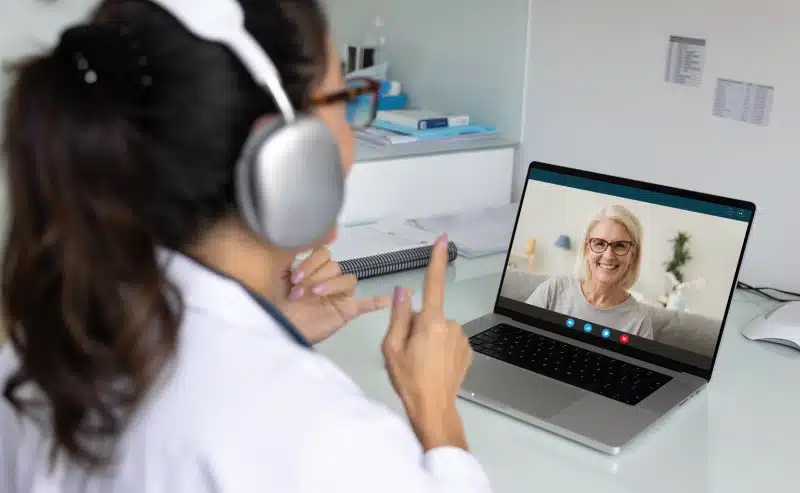
Virtual Doctor Visits Can Remove Everyday Barriers
Telehealth for seniors works best when it solves a real problem.
A senior may need to discuss a symptom, review a care plan, ask about medication instructions, or follow up on an existing condition. Some of those conversations can take place from home.
That matters more than it may sound.
When care feels difficult to access, people sometimes postpone smaller concerns. Those concerns do not always become emergencies, but waiting can create more uncertainty for the senior and the family.
Virtual visits give patients another path.
We do not expect virtual care to replace the physician relationship. We see it as another way to keep that relationship active between traditional office visits.
A patient should not have to choose between ignoring a concern and spending an entire day getting an answer.
Remote Patient Monitoring Gives Care Teams a View Between Visits
An office visit captures one moment.
Health continues to change after the patient goes home.
Blood pressure may rise. Weight may shift. Blood sugar may move outside a normal range. A senior may feel different several days after an appointment.
Remote patient monitoring gives care teams another source of information between scheduled visits.
At VirtuMedex, we use connected medical devices for appropriate patients. Depending on the care plan, a senior may use a blood pressure monitor, scale, glucose device, or another approved tool at home.
The important part does not come from the device alone.
The information has value because a care team can review it and decide whether the patient needs follow-up.
A 2025 randomized clinical trial followed older adults with hypertension and type 2 diabetes. Participants who received a mobile telehealth program showed better blood pressure and blood sugar control than those who received usual care.
That does not mean every measurement predicts a problem. It means health information from home can give clinicians more context than a single appointment can provide.
Chronic Care Support Makes the Time Between Appointments Matter
Older adults often manage more than one health concern. That can create pressure on both patients and practices.
A patient may need clarification about medications. A new symptom may raise questions. A change in a chronic condition may require attention before the next scheduled visit.
Without a clear support structure, those questions can move between staff members or remain unresolved longer than anyone would prefer. Our chronic care approach helps practices extend support across the month rather than concentrate every conversation inside a single office visit.
We can support eligible patients through chronic care management and remote patient monitoring while we coordinate with the existing provider relationship. This gives organizations another way to stay connected to patients who require ongoing attention.
It also helps senior care feel less fragmented. The patient has a clearer path for support, while the practice gains another way to maintain continuity.
Better Senior Care Should Not Create More Complexity for Staff
Virtual care only helps an organization when the model works for the people who deliver care.
Adding another platform or another stream of data without a clear process can create more work instead of solving a problem.
We approach virtual care differently.
At VirtuMedex, we help our partners build support around the clinical workflow rather than hand them technology and expect staff to manage everything alone. Our role can include patient support, remote monitoring, chronic care services, medication support, virtual access, and care coordination.
That allows organizations to expand the care they provide beyond scheduled visits without asking every staff member to take on an entirely new job.
Technology matters, but workflow matters more. A good virtual care program should give the care team useful information and a clear path for action.
Family Communication Works Better When the Care Plan Stays Clear
Families often play an important role in senior care.
An adult child may help with transportation or appointments. A spouse may notice subtle changes first. Another relative may live several states away but still take part in health decisions when the patient wants that support.
Care organizations often have to work within that reality.
Virtual care can make communication easier when the patient gives permission. Family members may join appropriate virtual conversations and hear the plan directly.
That can reduce some of the confusion that occurs when important information passes through several people after an appointment.
We still keep the patient at the center.
At VirtuMedex, we believe care should support family involvement without taking control away from the senior. The patient should understand who participates and how the care team uses health information.
That balance can help providers support the family without weakening the patient’s independence.
Simple Technology Helps Senior Care Programs Work in Real Life
A virtual care program can look impressive on paper and still fail if patients struggle to use it.
Older adults should not need advanced technical skills to take part in their care.
That matters for organizations too. Complicated technology can create more support calls, more frustration, and lower participation.
We focus on making the patient experience as simple as possible.
Some of our remote patient monitoring devices use cellular connectivity. Supported devices do not require home WiFi or Bluetooth pairing. The senior can take the appropriate measurement. The device can send the information. The care process can continue without turning technology into another burden.
For our provider partners, that simplicity can make virtual care easier to introduce to older populations.
How We Help Care Organizations Improve Senior Care at Home
At VirtuMedex, we focus on the gap between the medical encounter and the patient’s daily life.
Our partners already know how to care for their patients. We help them extend that care beyond the walls of the practice or facility.
Through remote patient monitoring, chronic care management, virtual access, medication support, and care coordination, we help organizations stay connected with eligible patients after they return home.
For the patient, that can mean easier access and greater confidence.
For the organization, it can mean better visibility into health changes and stronger continuity between encounters.
That is the role we want virtual care to play.
We do not want to add technology simply because technology exists. We want to help care teams use it in a way that supports their workflow and gives older adults a better experience at home.
A Stronger Connection Between Senior Care and Home
Senior care does not stop when the appointment ends.
The patient’s health continues to change at home. Questions appear there. Medication routines happen there. Daily measurements happen there.
Care organizations need practical ways to remain connected to that part of the patient’s life.
At VirtuMedex, we help build that connection.
We give care organizations another way to support older adults between visits while the patient’s existing care team remains central to the relationship.
That is how virtual care can help seniors stay independent longer while helping providers deliver more connected care.